Page 11 of 34

Posted: Wed Jan 20, 2010 10:16 am
by odyssey
Hi! tyrano34.
This is Taro's web-site.
He's very conversant about freshwater goby.
I have associating with him for several years.

Please pay attention to a text of this URL.
" nijiiro" is Japanese and the meaning is "Rainbow-color".
Those selling name is a rainbow color bonze goby, a red fin neon goby, an elegant bonze goby in Japan.

The most of Stiphodon imported from the Asian neighborhood of equator are "Rainbow-color" in Japan.
Probably I suppose that the situation is the same in the Europe.

The scientific name of "Rainbow-color" is unclear.
There is not the conclusive evidence whether they are single species.

Even the ichthyologist who performed their DNA analysis avoids the identification of the scientific name.
It is difficult for an amateur to distinguish it only by a color and a pattern.
tyrano34 wrote: stiphodon elegans ( yes or no)
http://www.okinawa-kaeru.net/wild/nanyo ... aze-3.html
This scientific name notation is an error.
The Japanese name is written definitely.
This is S.percnopterygionus.
tyrano34 wrote: http://w3.u-ryukyu.ac.jp/coe/action/new ... wsl10.html
have see so many different pictures on the Stiphodon elegans.
I believe that 2 upper pictures are S.elegans for certain.
This website is the one from University of the Ryukyus, and a photographer is Maeda doctor of ichthyographer.
It was investigated scientifically at a Tahitian Moorea island.
http://www.tahititourism.com/islands/moorea/moorea.asp
Dr. Mukai of the ichthyologist compared DNA of "Rainbow-color" with S.elegans.
Though "Ranbow-color" is a close species according to it, it seems to be another species.

Stiphodon can change the body color and the pattern drastically.
All following pictures are males of my S.percnopterygionus.(plural male states)
I made realize that it's difficult to see variety of my S.percnopterygions
and specify the species of Stiphodon by a little difference between the body color and the pattern.
Only the male of S.percnopterygionus is long and a sharp dorsal fin is characteristic, so it can be distinguished.

Image
Image
Image
Image
Image
Image
Image
Image
Image
Image
Image
Image
Image
Image
Image
Image
Image
Image
Image
Image

Posted: Wed Jan 20, 2010 1:21 pm
by plaalye
Great pics and explanation odyssey! The diversity in color for a single species is astounding! Really makes the point of how difficult it is to ID by color & appearance.

Posted: Thu Jan 21, 2010 10:59 am
by plaalye
I was searching the net for gobies to ID a new species that arrived at my LFS, I'm thinking lentipes?, and found this article you might find interesting. Goby pics are on pages 38-40
http://hbs.bishopmuseum.org/publications/pdf/tr45.pdf

Posted: Fri Jan 22, 2010 12:02 pm
by tyrano34
laugh. ah ah ah, I see it all the same pdf, enthusiasts will find.

Odyssey thank you for your explanation, I wonder if they put little shrimp with stipodons?

hi plaaye, you has photos of fish lentipes?

Posted: Sat Jan 23, 2010 1:17 pm
by plaalye
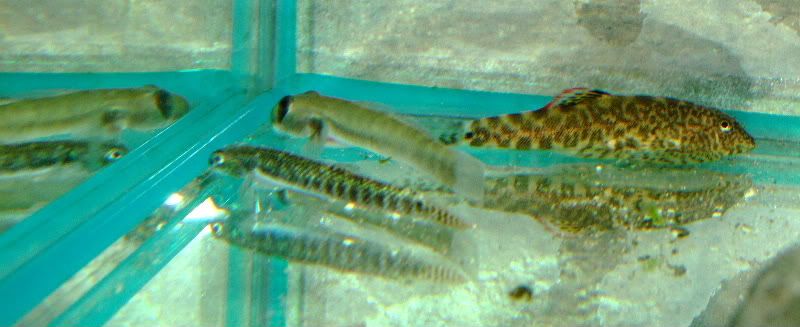
I took a few at the fish shop but they are'nt good. I posted these on yahoo goby group for ID. The fish are small and new to the tank so not showing much color. They look similar to l. multiradiatus.

Image
Image
Image

See also: http://www.petfrd.com/forum/showthread.php?t=26282

Posted: Sat Jan 23, 2010 1:29 pm
by tyrano34

Posted: Sun Jan 24, 2010 12:36 am
by odyssey
Hi tyrano34 and plaalye !

Video clip; Lentipes male is making nests.
http://www.youtube.com/watch?v=gChkNHtOoeQ

My Lentipes multiradiatus.
Image
Image
Image
Image

One useful link.
http://www17.tok2.com/home2/tarogoby/zu ... yoroi.html

The shrimp can live together with Stiphodon.
There is always shrimps to my water tank.
Image
Image

Posted: Sun Jan 24, 2010 2:13 am
by odyssey
Hi plaalye!

Thank you for introducing an interesting link.
The picture of Stiphodon rutilaureus appears in the PDF document, too.

I'm very interested in Stiphodon in the Southern Hemisphere.
But I have not heard that those were imported.
Stiphodon rutilaureus in New Caledonia can see below.
Taro's superior website.
http://www17.tok2.com/home2/tarogoby/zu ... ureus.html

Posted: Wed Jan 27, 2010 9:37 am
by wasserscheu
thanks Odyssey for the picture summary of one individual in various colors, very good documentation. I have only 2 or 3 pics with different colours on one male.

Looks like I just bought 2 stiphodon (a bit expensive though) of the rutilaureus yesterday. But they are still too small and greyed out (in med. tank for another 2 hours) to take pic's. They also could be "rainbow-coloured" ones, time will tell. ...

I also got a hand full of sicyopterus (possibly the "lagoxxxx" ones) which are in q-tank for week now. I will post pic's in a while. I've put some more Pseudogastro's (cheni) together with the 2 stiph's and 3 more sicyo's but I have the feeling the Pg's are too agile for the very soft appearing sicyo's and may need to make 2 q-tanks ... (most likely connected somehow, we will see).

Congrats on the lentipes Dave, very nice :!:

Posted: Wed Jan 27, 2010 6:32 pm
by wasserscheu
After preventive medication against ich and after hooking the 2 q-tanks together, I found that the Stiphodon below shows ich. Which I did not spot before. I should have left the 2 q-tanks seperate...too late, that's what I get for being greedy :roll:

Here one each of the additions

Image

I'll wait with the sand, to see how it goes, getting ready for a second round. I feel sorry for them being on the bare glass, but it's better that way for now.

Posted: Sat Jan 30, 2010 10:13 am
by odyssey
Hi ! wasserscheu.
wasserscheu wrote: for the picture summary of one individual in various colors.
Sorry,my English expression seems to have been inappropriate.
The various photographs of percnopterygionus mentioned above are plural male states.
There are one male various changes in the following links.
http://forums.loaches.com/viewtopic.php?t=15686&start=0

I think it can be confirmed whether it's S.rutilaureus before growing.
Mr Taro is describing the difference in the shapes of the second dorsal fin as the shape peculiar to S.rutilaureus in the websites mentioned above.
While the shape of the second dorsal fin of other Stiphodon is the parallelogram, S.rutilaureus has a shape like the quarter oval.

I got small Sicyoputerus.sp, too.
They were sold as an azure bonze goby from Indonesia.
I think Sicyopterus macrostetholepis or the related species, but it isn't certain.
Image
Image
Image

Also various sample pictures of "Rainbow color" are uploaded .
Though plural species may be mixed, I cannot distinguish them by color and pattern because their change is too big.
Image
Image
Image
Image
Their cheeks can be rarely golden.
Image
Image
Image
Image
Image
Image
Image
Image
Image
Image
Image
Image
Image
Image
Image
Image
Image
pictures of diversity of "Blue moon" and "Orange fin" may also be uploaded over it.

Posted: Mon Feb 01, 2010 2:44 am
by wasserscheu
thanks Odyssey for your precise information regarding the male's appearance and sorry for missreading from my side.

I will have a look at the 2nd dorsal of my surviving (new) male and compare with your new data, thank you. But I guess it's a "rainbow" we will see.

Your pictures are always impressive.

Posted: Tue Feb 02, 2010 11:00 am
by tyrano34
hello my friends

What is the parameter which changed the color of fish?
temperature, water parameters, behavior, visual environment, food ...

Posted: Tue Feb 02, 2010 12:21 pm
by plaalye
Mine change so often it would be difficult to say exactly why? Food, the presence of other gobies, camouflage, their moods change rapidly!

Posted: Tue Feb 02, 2010 1:30 pm
by tyrano34
But mine not change color, they are just being too young or are not yet adapted to their environment.

You would have a picture of your aquarium plaaye, please.