Page 3 of 4
Posted: Sun Nov 12, 2006 5:25 pm
by shari2
Cant help but feel cheated about he way that my paper is being distributed without my consent, thanks guys. lesson learned
I have sent the paper to Graeme, Martin and adampetheric. If you object, once again, my apologies.
I have written a paper on the subject of hormone injections in which I will detail the process. I will publish it on WW if thats ok with the admin staff.
Since I read this in the thread over at WW I thought you had intended to openly publicize the study and was willing to freely share the information. Sorry for not running this by you prior to disseminating the information. If you wish to share the paper with anyone else that will be your decision. I am officially out of this discussion.
..........................edit
It is also publicly posted on the forum here
Posted: Sun Nov 12, 2006 11:45 pm
by Vancmann
I strongly believe these photos were NOT photoshopped because I have seen it before. A few months ago I noticed one of my smaller loaches developing these exact bumps, not quite as pronounced, on his head. I have never noticed these bumps prior to this and I thought he was getting sick or something although he was not acting sick. He was actually chasing the largest and fattest loach ( I assume a female) quite agressively. She normally rules the tank. These tubercles have dissapeared from him since then, since I have relocated the fish tank. I don't recall it being there for more than a couple weeks. I only now remember this because of these photos. Wow, I thought I was the only one with this problem, only now, not a problem. It feels good to know that there is someone out there who have had the same experience with their loach as I have
Posted: Mon Nov 13, 2006 10:03 am
by midman
Posted: Mon Nov 13, 2006 10:06 am
by midman
I believe these sensory detectors are probably more akin with water conditions / prey in the water and the loaches ability to locate food properly. Maybe someone should contact the loach breeders and find out if they get this happening when the loaches are forced to breed via hormone treatment. I get the impression that nothing is set in stone as far as sexing Clown Loaches so I hope my thoughts are not considered out of place.

Posted: Mon Nov 13, 2006 4:11 pm
by adampetherick
midman wrote:I believe these sensory detectors are probably more akin with water conditions / prey in the water and the loaches ability to locate food properly. Maybe someone should contact the loach breeders and find out if they get this happening when the loaches are forced to breed via hormone treatment. I get the impression that nothing is set in stone as far as sexing Clown Loaches so I hope my thoughts are not considered out of place.
Not sure if the breeders would be that keen on giving out the 'secrets' of breeding
Posted: Tue Nov 14, 2006 8:55 am
by pintius
smaller less pronounced bumps are readily visible on the head and are indeed sensory in origin. Think a few of you are confising these with my theory on tubercles. The tubercles are much larger and resemble grains of salt or ich. The 2 are totally different and are NOT related
Posted: Tue Nov 14, 2006 11:08 am
by Emma Turner
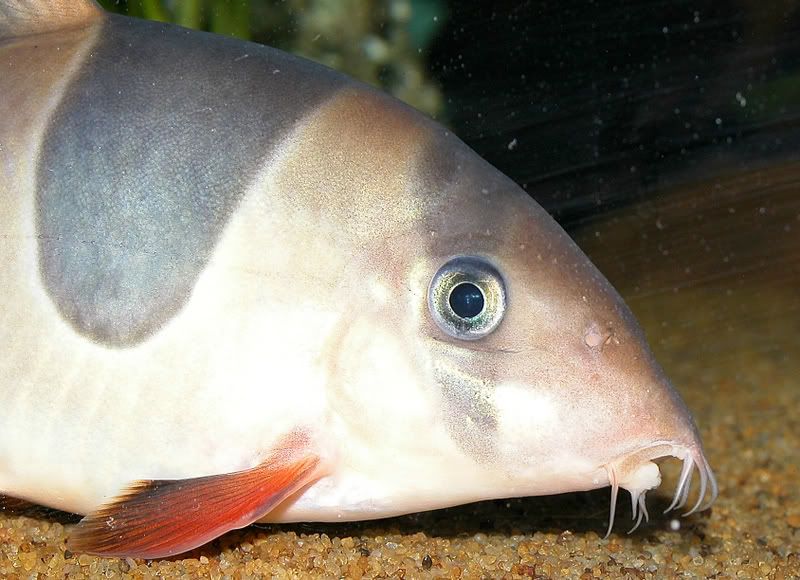
Here's an old pic of one of my many clowns, showing pores on the head region. I believe this to be a female, although with this being one of my smaller specimens, cannot be 100%.
pintius - how big is the loach you have shown in your photographs?
Emma
Posted: Tue Nov 14, 2006 3:06 pm
by pintius
You can see the tubercles much easier if you look at the head from above, allthough the picture above is of higher than average quality I cant really see if there are tuberclesas as they tend to be most concentrated on the top of the head. The specimen Ive shown is around 7 inches.
Posted: Wed Nov 15, 2006 5:23 pm
by Vancmann
Posted: Sat Nov 18, 2006 3:43 pm
by pintius
Tubercles - male.
The difference between tubercles and sensory pores is obvious when you know what you are looking for (as you now do), these are clearly tubercles from a sexually mature male
Like you I initially thought that the fish was ill
If you compare your picture with mine you will see that the tubercles are identical
Posted: Sat Nov 18, 2006 5:38 pm
by Emma Turner
The 'tubercles' in pintius's pictures appear to only show on the 'naked area' of the head, whereas in Vancmann's pics (particularly pic no. 2) these seem to be extending further back.
Vancmann, out of interest, how often are you seeing these 'tubercles' on your fish?
Emma
Posted: Sat Nov 18, 2006 6:32 pm
by Hurricane Charlie
How long have people been keeping clowns in aquariums? And nobody has noticed these things before? Obviously it doesn't looke like it would require a supre zoomed in view to see what your calling "breeding Tubercels".
Sorry I just have a hard time buying that somthing so obvious looking has just now been "discovered".
Posted: Mon Nov 20, 2006 7:33 pm
by Vancmann
To see the full detail of the "tubercles", I had to use the camera on macro mode. To the eyes, they don't appear as easy as the camera shows. Possibly attributed to lighting, but only from a close distance (within 10 to 18 inches) are these "tubercles" visible on my fish and they don't standout as white as the photo shows, it is more of a rough forehead look. That could explain why I have never noticed this before. I bought this fish as a little pup in 1997 and he is the youngest, though not the smallest. I first noticed it about 3 months ago and now since this topic has started. To my knowledge he has had these "tubercles" since then and it has grown over a larger area of his body because it now covers the area from the front of his dorsal fin to his nose. During the period of first noticing it and 7 days ago, I cannot say if it went away so I do not know the duration of how long its been on him or how often it shows up.
Posted: Mon Nov 20, 2006 8:00 pm
by Vancmann
This is what he looked like on may 27th 2006 when I uploaded this pic to my computer. Here he is seen eating brine shrimp that got stuck in the filter. The "tubercles" are not visible here. As of yet, I have not been able to find any other and older pic of him with the "tubercles". I will have to dig through my archive.

Posted: Tue Nov 21, 2006 4:42 pm
by Desi
Wow, This is very interesting. My largest clown also has bumps on his/her face. When they first started to appear I watched closely for ich as they looked like it but not quite as white. Its almost like there are pimples. They started out with a few and they kept gathering more and more. But they do seem to be "engorged" at times because they are very noticeable during this period. I haven't really noticed it on my other 2 large ones (4"+). I'll try and get some pictures but my camera isn't that great and the loaches do not like the one eyed monster at all and you gotta be relatively close to get a good view. Also I'm not exactly sure of the age of my oldest Clown, I bought him/her with a used tank in Dec. '03 at that time the lady said he was a few years old and he was approximately 3" so I would guesstimate 5-6 years old. The other 2 large ones I purchased on Jan. 2, 2004 to provide my lonely clown company so they are probably around 3-4 years old as they were smaller around 1.5".


