Page 3 of 7
Posted: Sun Aug 26, 2007 3:00 am
by Graeme Robson
Marvelous video and pictures!!

Posted: Sun Aug 26, 2007 7:28 am
by KhuliKhilla
oh my.
this is such a terrible temptation. plans for the new flat include two new tanks - one was going to be a breeding tank for my L134 plecs, now im wondering how much convincing Dave will need to get a grrrrr tank for these beuts
Posted: Sun Aug 26, 2007 12:14 pm
by piggy4
Wonderful pics Emma, can't wait to see a fully grown specimen ! i suppose these will alter quite markedly ? its really exciting though, i just picked up half a doz from BAS, my first guess is that they are a S.Helodes ! but i must say the strpes are really dark ,if not black, then perhaps a blackish green ? plus so far there are no little spots on the abdomen, i have seen tiny Beauforti , and i'd say they were pretty much little carbon copys of their parents ! very exciting, CANT WAIT.
Posted: Sun Aug 26, 2007 12:32 pm
by The.Dark.One
Not sure if they are a new species. I suppose we will have to wait and see what they are like when older. I would suggest that the thin bar thicker bar pattern will turn into just bars of similar thickness and height when they get to adults. They appear to have 11 branched dorsal rays (if you count last one as one). Most helodes have a minimum of 12 (although I know of one count for Vietnam specimens of 11 but this may be in error). They could be young Mekong 'form' of beauforti. Once (if) we find out the locality this may help.
Posted: Sun Aug 26, 2007 12:59 pm
by Graeme Robson
I can see this turning out to be a interesting debate as these little chaps grow. Below is an image of a juvenile
Syncrossus beauforti for comparison with the new Yellow Tiger loach.
Picture courtesy of James Forgan
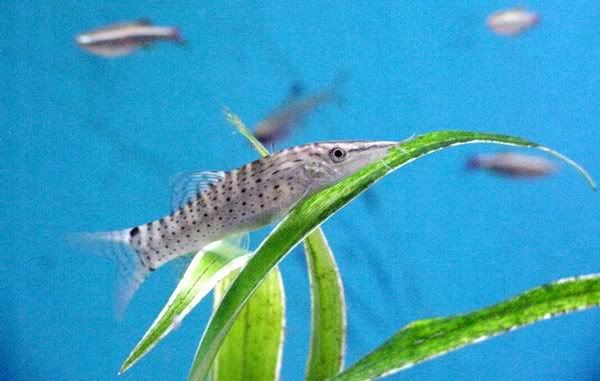
And Emma's picture
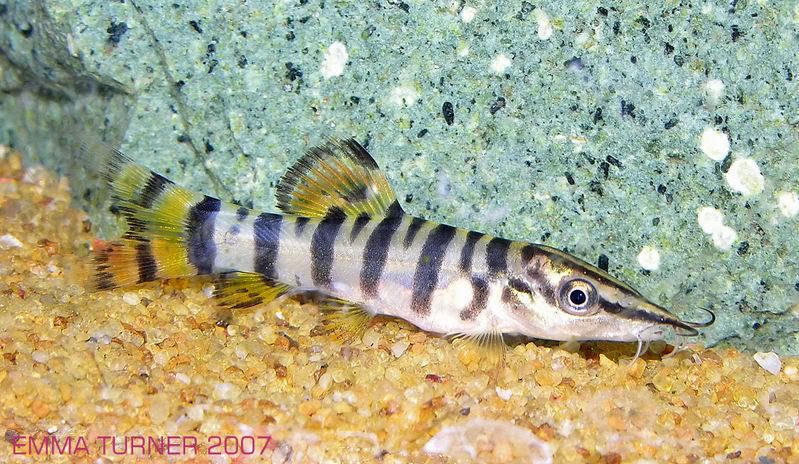
I can see where Andy is coming from with the
Syncrossus helodes. These do hold the yellow colouration on the fins and especially on the anal fin.
Interesting times ahead!!

Posted: Sun Aug 26, 2007 3:10 pm
by helen nightingale
look at those barbels
Posted: Sun Aug 26, 2007 8:15 pm
by Dr. Momfish
I need to stay at the Off Topic section. Looking at these pics makes me want. Must not. Must not. Martin has custody of the loaches.
Posted: Sun Aug 26, 2007 8:19 pm
by helen nightingale
go on, just the one....
(i will leave the second half of that thought off as it is only suitable for the OT)
Posted: Mon Aug 27, 2007 3:51 am
by The.Dark.One
Graeme Robson wrote:I can see this turning out to be a interesting debate as these little chaps grow. Below is an image of a juvenile
Syncrossus beauforti for comparison with the new Yellow Tiger loach.
I can see where Andy is coming from with the
Syncrossus helodes. These do hold the yellow colouration on the fins and especially on the anal fin.
Interesting times ahead!!
Hi Graeme
The picture by James may be of one of the different forms (from a different river system) of beauforti. However, I agree that the patterning is more like a helodes than a beauforti form. There are variants of helodes with yellow fins (see image in Fishes of Laos) and I have images of preserved specimens with yellow fins from a different river system.
We shall see!
Posted: Mon Aug 27, 2007 10:01 am
by Graeme Robson
Indeed we shall your Darkness.

Posted: Mon Aug 27, 2007 11:06 am
by Martin Thoene
Dorsal ray count is too low compared to Fishbase morphology (12 - 14) to be helodes.
Martin.
Posted: Mon Aug 27, 2007 2:17 pm
by The.Dark.One
Martin Thoene wrote:Dorsal ray count is too low compared to Fishbase morphology (12 - 14) to be helodes.
Martin.
The problem is that there may be more than just one helodes 'form' based on what I have researched so far. One worker in Vietnam states they have found specimens with 11 (but sometimes workers dont always count the last ray so if so that would be 12).
11 is on the high side for a beauforti form, they usually only go up to a 10, but there may be specimens out there with 11. However, I take the point that the body pattern is not like young beauforti forms. If it isnt an helodes form, it could well be a berdmorei form as they may go up to 11 rays, but if so that is much further east than the currently known range for the berdmorei forms, so that brings that possible ID into question. WE NEED TO KNOW WHERE THEY ARE FROM AND SEE AN ADULT!!!!!!
Posted: Mon Aug 27, 2007 7:32 pm
by Emma Turner
I'm going to try and do a bit more investigative work to see if my sources are willing to reveal any more details.
Emma
Posted: Mon Aug 27, 2007 9:03 pm
by Emma Turner
For interest, I thought I'd add these pics from Kottelat's 'Fishes of Laos':
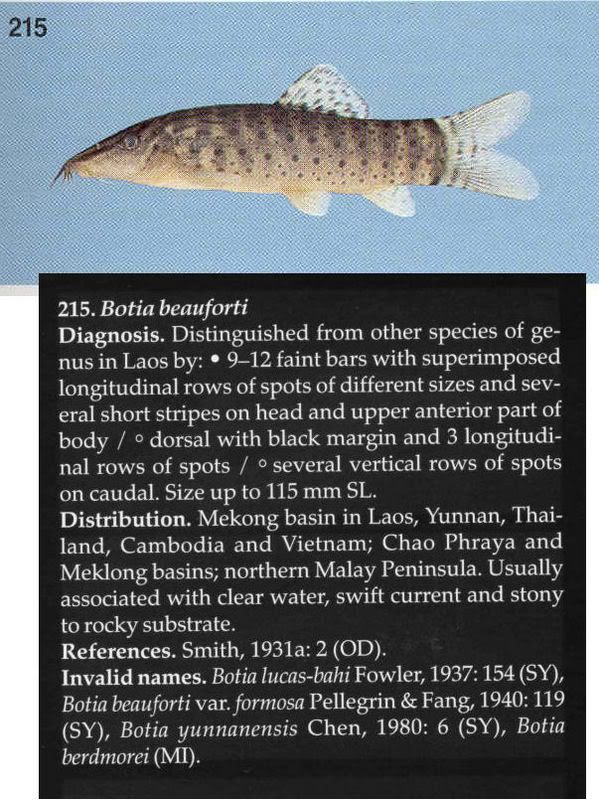

(sorry, don't know why the text came out differently)
The supplier, by the way, has assigned a latin name of
Botia cf. beauforti to these fish. They have to give some sort of indication for exporting though.
Also, in this same book, did anyone notice the body markings on the juvenile
Yasuhikotakia lecontei? I know they are striped when young, but the bars in this picture bear a striking resemblance to these juvenile Yellow Tigers! Obviously not a match for other reasons, but it just goes to show how drastically these loaches can change from juvie to adult.

Emma
Posted: Mon Aug 27, 2007 9:37 pm
by Afonso
This is a juvenile beauforti.

and this is an adult beauforti
