Page 7 of 11
Posted: Sat Mar 04, 2006 2:16 pm
by cybermeez
mikev wrote:I like to think of a kuhli's stripes as being similar to those of tigers. You can see any given tiger and know it's a tiger. They all have stripes, but no two individual's patterns are exactly the same. Unless you know where it (or in the case of captive bread tigers it's ancestors) came from, you can't know if it's a Bengal Tiger, Sumatran Tiger, an Amoy Tiger, an Amur Tiger or a Siberian Tiger. You can make an educated guess based on slight variations between species, but it's very hard to be 100% certain in most cases.
This is actually a very good example. You see, tiger "species" do not seem to be true species but rather geographic variations. ASAIK, they all interbreed. Heck, tigers even interbreed with lions, but we probably don't need to go
there. Truely different species do not interbreed, or produce sterile hybrids.
I briefly cover the possibility of cross-species breeding in the upcoming loach book. I certainly wouldn't rule it out, particularly in captivity. However, in the wild geographic distribution and internal anatomical differences between species (i.e. differnet numbers of vertebrae, positioning of fins on the body and number of fin rays) all poit to several differnt species of striped kuhlis.
Posted: Sat Mar 04, 2006 2:31 pm
by mikev
I briefly cover the possibility of cross-species breeding in the upcoming loach book. I certainly wouldn't rule it out, particularly in captivity. However, in the wild geographic distribution and internal anatomical differences between species (i.e. differnet numbers of vertebrae, positioning of fins on the body and number of fin rays) all poit to several differnt species of striped kuhlis.
Any chance I can read more about the anatomical differences?
This will be a very strong indication indeed, particularly vertebrae differences. (Fin rays make me think about plecos, where it is not a factor).
Posted: Sat Mar 04, 2006 2:47 pm
by cybermeez
mikev wrote:
Any chance I can read more about the anatomical differences?
This will be a very strong indication indeed, particularly vertebrae differences. (Fin rays make me think about plecos, where it is not a factor).
I've see Kotelatt mention internal anatomy in at least one paper, but I don't remember which. All mentions to this sort of thing would be found in the scientific literature and you'll need to do some digging to find it. Loaches, and Pangios in particular, and not nearly as extensively researched at this point as many other fish. There are only and handful of researchers interested in Loaches. On a side not I also read somewhere recently that someone was doing DNA sequencing on Botias. I think that sort of research could prove very interesting with respect to any connections between Kubotais, Histrionicas and Rostratas.
Posted: Sat Mar 04, 2006 2:55 pm
by mikev
I'll certainly do the digging, unf. it will take some time (our library is not likely to have these journals and interlibrary is not instant). So if anyone has anything already scanned it will be much appreciated. The more data the better. If the scans are of good quality I'll volunteer to OCR them (searchible pdf's are much better).
Kubotais, Histrionicas and Rostratas is certainly one other interesting area, and the possibility of 2 species of yoyo's is another (I'd like to bring this up some time soon too, but not on this thread). Schistura cluster is the obvious 3rd.
But IMO Pangios should be the focus.
---
I'm curious in particular if the anatomical differences are between P.M. and P.S.... That P.Javanicus is another species I think we can accept: really different body shape and almost complete absence of sexual dimorphism are good reasons enough for me.
Posted: Sat Mar 04, 2006 3:26 pm
by OohFeeshy
RE pattern variation, these are the shots I've managed to get thus far. With the fake pygmy chain sword I've added, and the extra wood, the black kuhli is the only one that ventures out...
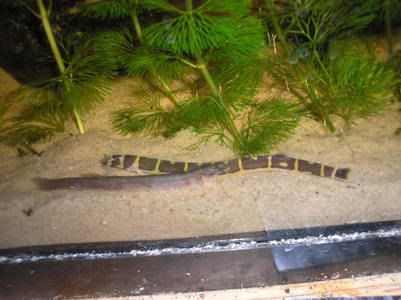
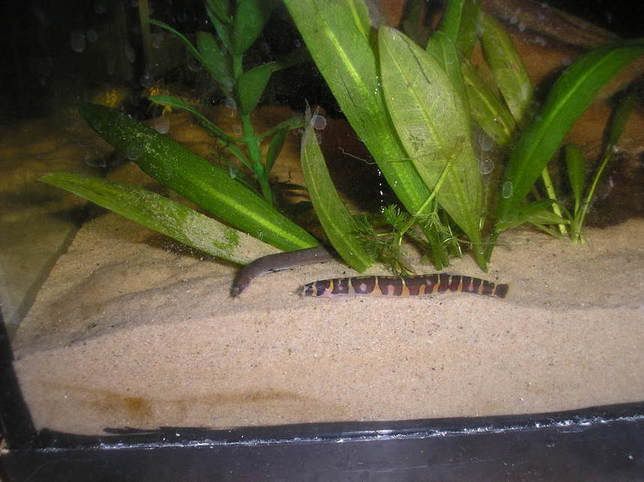
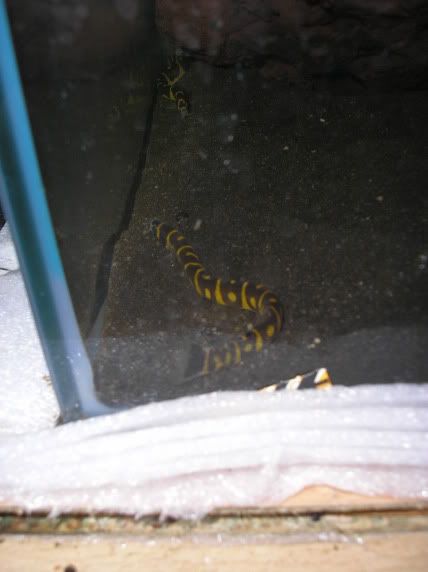
The last picture shows, IMO, the best pattern variation I have, although either the pattern has changed slightly or this was the one who got caught in the filter

I'm currently looking to make a group of around 20 ish in the 20g, I have ~10 at the moment, but the problem now is the only shop that still sells kuhlis is Maidenhead Aquatics, which charges almost £4 per loach, and they are very small, skinny and generally unhealthy looking. All these were from a shop that has stopped selling all tropical fish, the loaches were all suprisingly healthy, considering the gravel base and no hiding places (except behind the heater). I think what we really need is decent information from the people who actually catch them, whilst seperating each species/subspecies is pretty impossible, at least we should be able to replicate where they are actually caught. I think in the future, pending some decent information, I need to save up and buy an entire bag of kuhlis straight from an importer, not only will this work out cheaper, but also means a great deal more variations can be observed, as well as what causes KUSS, and also many more social aspects of their lives.
Posted: Sat Mar 04, 2006 3:42 pm
by mikev
Glad to see you around, OohFeeshy,
Based on my limited understanding of the classification, the top loach is P.Myersi, the 2nd is P.S., and the last one is P.P. (P.Problematicus).
I remember seeing in one of the previous khuli discussions on TFF a photo of a couple of Khulis which had very strange bending lines...like a Burmese-style drawing...If you happen to know what I mean and where it was, those pictures would be very nice to see here.
Posted: Sat Mar 04, 2006 3:44 pm
by Emma Turner
the only shop that still sells kuhlis is Maidenhead Aquatics, which charges almost £4 per loach, and they are very small, skinny and generally unhealthy looking.
There are over 50 branches of Maidenhead Aquatics stores, so you should not assume all are run the same.
At Peterborough, our kuhlis are quarantined for around 3-4 weeks, in which time they are treated with Levamisole for internal parasites, and are fed intensively before being put on sale. Incidentally all the loaches in our store are kept on a sand substrate and have lots of hiding places. Prices will vary from store to store, depending on where livestock is sourced from. But generally our kuhils are usually between £1.50 and £2.00 each.
Emma
Posted: Sat Mar 04, 2006 3:58 pm
by mikev
OohFeeshy,
the kind of quarantine Emma does basically guarantees that the khulis will survive in your tank, if you don't make any bad erros.
Hi, Emma:
At Peterborough, our kuhlis are quarantined for around 3-4 weeks, in which time they are treated with Levamisole for internal parasites
I'm very curious if there is any evidence that this actually needs to be done. Of course, it is much better to err on the side of safety, but do we know of any case of khuli with internal parasites or a version of the Skinny Disease?
Posted: Sat Mar 04, 2006 4:20 pm
by OohFeeshy
Emma Turner wrote:
There are over 50 branches of Maidenhead Aquatics stores, so you should not assume all are run the same.
I didn't say they were, I was referring to the branch nearest me, although I want to go there anyway so I'll check out what they have in.
When I was taking some of the substrate out of the tank mine are kept in (you can see how ridiculously thick it was

), I was going to take a photo of each one of mine, but I forgot
. Whoops... Still, I might transfer the group back to the tank with the black sand, it seemed to really bring out the colour and gave a lot of hiding places for them. It should still be able to support a group of around 20, if I only have one or two mid dwellers.
Posted: Sat Mar 04, 2006 10:14 pm
by mikev
Best I can do for now; this is the other side, but unfortunately in two pieces.


It is irregular to the extreme. The odd-shaped yellow pieces do not seem to be from a trauma (I looked carefully).
Poor girl spends most of the time curled in the corner of the tank, including being upside down for long time (one warning sign). The other warning sign is that she was egg-laden on Wednesday and lost it now. This is the 2nd time this happens, and I hope it does not represent a pattern. Because of eggs, she got very careful 2hrs acclimation, and it still happened.... -- another khuli mystery.... anyway these probably were the best pictures for a few days.
I think she represents a good counterexample to the P.M.-P.S. classification, and I have more inside the other tank.
Two more things noticed:
I really wonder why all good P.Myersi's I have (including this one) are females.... Do you have a good picture of a certain male P.M. ???
Also: looking at the picture I posted yesterday: khuli #1 may be another pattern-shifter. I'm nearly certain that the front stripes changed since January. I'll watch him more carefully.
Posted: Sat Mar 04, 2006 10:22 pm
by cybermeez
I'd say that's a P. semicincta. An up-side-down kuhli doesn't sound good. Martin's idea of of trying an almond leaf may net be a bad idea at this point.
Posted: Sat Mar 04, 2006 11:51 pm
by Wendie
I always keep an almond leaf in the kuhli tank.
How can you tell if it's a female - aside from the greenish belly coloring? The ones I've gotten by mail order are usually very small and thin.
Posted: Sun Mar 05, 2006 5:44 am
by Martin Thoene
Wendie, I think you are a LOL record holder. I don't think anybody has started a thread that's had this many replies or hits. Look at the figures on the Index. WOW!

Popular subject.
Martin.
Posted: Sun Mar 05, 2006 5:55 am
by Graeme Robson
As far as i'm aware, you cant tell the difference until they become "gravid". Or unless you have plenty time on your hands and notice perhaps males following the females. Or this is all "poppy-cock"

Posted: Sun Mar 05, 2006 6:03 am
by Martin Thoene
The pectoral fins of males are supposedly bigger than females, but you probably need two side by side in order to make that determination.
Here, the differences are quite clear, but you can't see those fins properly.

Pangio piperata
Martin.